INTRODUCTION
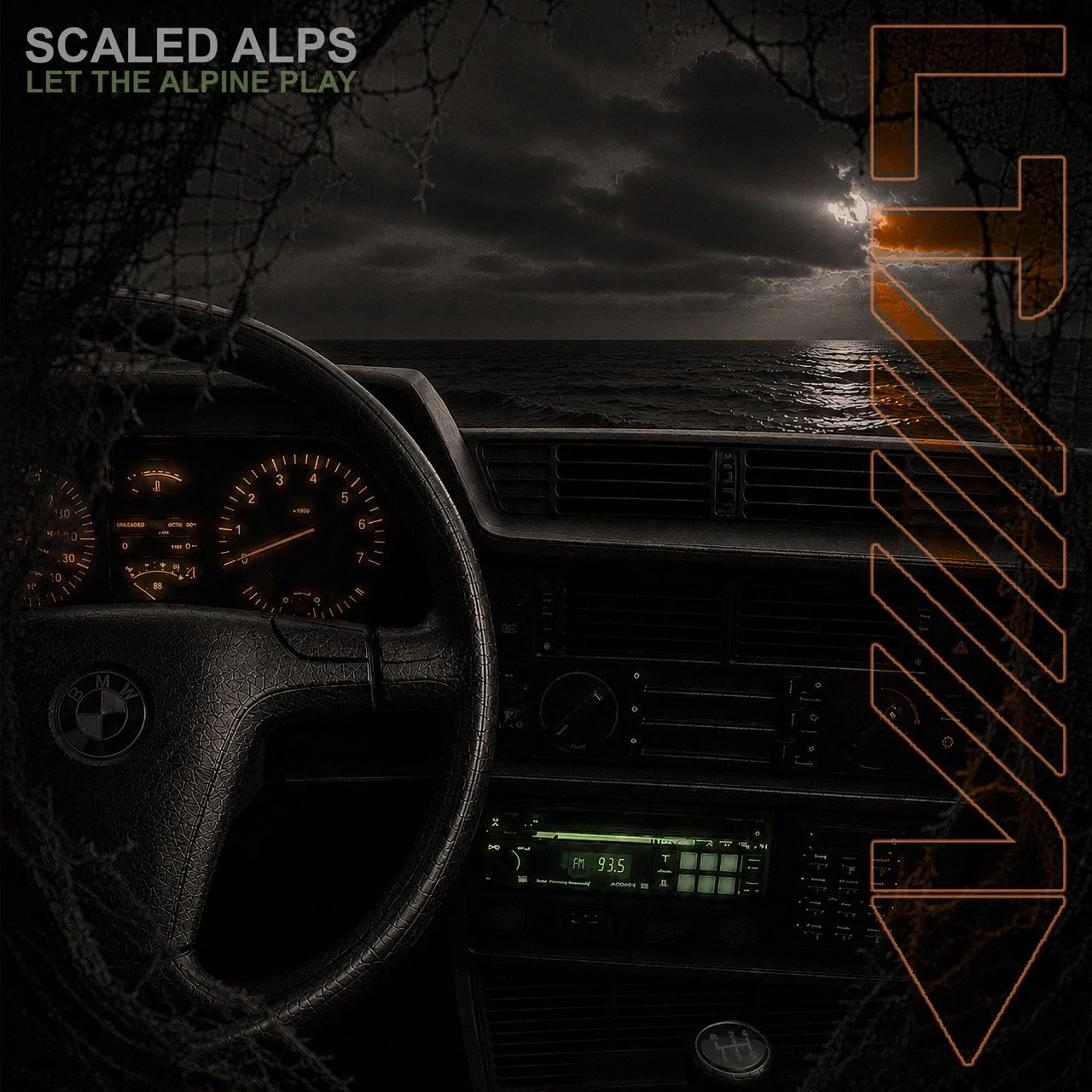
Let the Alpine Play began its life as a series of demos called ‘The Desertion Sessions,’ written and recorded in and around The Altar Studios in N. Hollywood, CA.
The self-recorded demos came in two frenetic sessions spanning day and night, yielding over 30 tracks.
Sixteen of the songs were then recorded with engineer Stewart Tuttle at the helm, Sean McCarthy on drums, and Steve Fishman on bass.
Sean makes alien glam pop music as Joan Darwin. He brought a singer/songwriter’s sense of hookiness to the drums, leaving a lot of space for Anthony and me to shriek and preen. Exactly the “serve the song” player you want in there.
Steve’s a seasoned vet whose most recent gig has been playing with Bay Area psych-punk legends Chrome. He’s playing upright, electric, fretless, and synth basses at various points and I’ve gotta say he’s relentless throughout, an absolute ringer we’re glad to have brought in.
We’d never worked with Stewart before and chose him because he was constantly working — we’d see him recording rappers, hardcore bands, country acts, R&B singers. I’ve got a particular respect for what you could call “the art-worker,” which is to say someone who is always doing and improving. Dynamos, dervishes. I wrote about our experiences with Stewart and the studio in a piece called “Make it Sound Like Amphetamine Teeth,” which you can read here.
“Amphetamine Teeth” ended up landing with people who actually study this stuff for a living: Dr. Paul Thompson at Leeds Beckett University said the piece connected with his research and pointed me toward academic work on studio language, translation and musical semiotics. Eric Clarke, Emeritus Professor of Music at Oxford, said he could “just about hear it in [his] head,” then sent me his own paper on musical perception. Veteran producer John Simon, guy who did the first Leonard Cohen record, called it “quite a dark view.” So the basic idea seems to hold up: musicians and engineers constantly use language that sounds ridiculous, but in the right room, with the right people, it can communicate something very precise.
Let the Alpine Play’s lyrics typically function as “quantum entendre,” which is to say that they can be interpreted in many ways, often creating unusual superpositions or conflicts of meaning.
The songs run like episodes, vignettes, plays.
Another Clock Song (The 7th Unveiling)
James Quentin Devine:
This one rides in heavy-lidded and seductive, declarative. This is a confidence job, literally. We want listeners to embody a song, to internalize it and feel it. That’s the role of the singer, to interpret the music for an audience in the sense of a shaman. “Incantation,” it’s right there, “put-song-in.”
Astute observers will note the title’s allusion to “Another Space Song” by Failure. Oddly enough the record’s gotten into the hands of Ken Andrews from Failure, who dug it. We may end up working with him, which would be fitting. This record’s really taken on a life of its own, in terms of pulling us in old and new directions. The post-COVID artistic landscape is, generously, a devastated wasteland. A lot of mid-career artists rage-quit, some just sort of stopped showing up. It’s difficult to tell sometimes if new “artists” are human, fake “old” music is being spun up by audio generators and retroactively implanted into “the culture,” it’s all very sinister . . .
Anthony Percoco:
This song has some wide intervals in the piano left hand and repetitive arpeggio figures in the right. Some guitar tapping and highly syncopated guitar leads come in near the end. More and more I’m finding it necessary to phrase in a more syncopative and less rhythmically obvious way to keep myself interested in what I’m playing. There are Sus 11 chords leaping rapidly through various octaves of the piano at the end. Stylistically I think a bit of McCoy Tyner with the open voiced sus 11 chords. The ending happened as an improvisation, all at once, completely unrehearsed in the studio.
2. Celestial Sighs
JQD:
Big song. Exercise in rollercoaster design, really.
AP:
I want to bring this song back around again, re-record it sometime with chorus in the keys and a double time rock feel in the chorus. I think it has an anthemic quality.
3. Southerly
JQD:
“Southerly” is one of the only songs on LTAP that was partially written in advance, if only as a voice memo. In its initial conception it had a bit more of a crunchy Jerry Cantrell da-dow-dow da-da-da-dow-dow thing that we eschewed in favor of the slinkier treatment that finds itself on the album, which does feel like a more appropriate approximation of slowly-moving fog.
AP:
Probably the most complex piece in terms of multiple sections and intricacy of the parts. I’d like to invoke our working draft of this when playing it live. I think I was levitating and sleep deprived when it was written. James had only the lyrics and counterpoint, and we wrote the rest in a span of hours in the studio writing space.
4. Space/Time
JQD:
An island of my own stranding.
AP:
Simple chord progression, but this one swings hard in the end. James asked me to take a lead at the end and he also suggested the vibraphone at the end.
5. Muffler (Chrome Viscera)
JQD:
This song was written in the parking lot of Sunrise Liquors, just down the street from the studio. I wrote it in five minutes while I was pacing around pounding a Pacifico and getting eyed by a face-tat homie. North Hollywood, city on the edge baby.
If a professional wrestling, auto racing, or combat sports organization isn’t using this as their theme by the end of the year I will have failed entirely in my mission in life.
AP:
Fun reckless abandon. I enjoy the bass tone and screams on this one.
6. T.T.M.S. (Sunyata)
JQD:
This one’s for walking around alone at night.
AP:
This song is perfect for the stillness of midnight. Very spacey but an “orchestrally” layered ending that crescendoed well. Sean and I improvised the entire ending and the recording is in the original one take. The “performance magic” happened in that take.
7. You Got H-O-R-S, You Want E Too?
JQD:
This is the riskiest song on the record, I think, in terms of alienating conventional audiences, an exercise in which we have previously excelled. It’s a funk song in an odd time signature with a harsh street life narrative. Not for everyone. We got that huge drum sound on the intro out of an unfinished room at The Altar, just a big bunch of exposed concrete, gives it a real sense of menace.
AP:
This is a sort of blues/jazz, I’d say. Lot of room to improvise. There was not a whole lot of time for tracking leads, unfortunately.
8. Pink Diamonds
JQD:
At some point I’d like to have the opportunity to apologize to Sade personally for this song.
AP:
Speaks for itself. Bass…
9. Neo Noir (Stelvio)
JQD:
Just close your eyes.
AP:
I felt we could have put chorus on the drums, in hindsight. The piano plays 3 voices simultaneously; bass, quick moving inner voices and melodic higher notes. The solo section aims for wide interval melody and syncopation. Then it hypnotically repeats and builds.
10. Selling It
JQD:
Ian MacKaye called this one “pure economy.” The lyrics call back to 2024’s “Venusian Furs” from our previous record Peak Arousal. We’re hoping to bring some of those songs back on the next record, like we did with “Throwaway Lines.”
AP:
I would have loved to extend this one. Sharp 9 Dom. 7 chords and a walking/arpeggiated bass. The chords are chromatically adjacent. Definitely need to improvise on this one live.
11. Slow Motion
JQD:
This is an attempt to get Birdman’s attention.
AP:
This might be my favorite from the album. The chorus really gains a lot of energy and the way the vocals cut through the layers worked out well.
12. Impro (The Imp Of The Perverse/The Pimp Of The Inverse)
JQD:
“Impro” is goofy as hell, commentary on awareness and social comfort and inside jokes. “Shtick,” you might say. Gimmickry. This is the most we have ever sounded like the Red Hot Chili Peppers, and if someone doesn’t stop us, we might do more of it.
AP:
This one has chromatically shifting tritones in the piano that remind me of how Chopin’s “Tristesse” is played. But of course it’s highly syncopated and jazz/funk adjacent.
13. I Think We Met In Setagaya (Maybe It Was Seville)
JQD:
Unreliable memory strikes again.
AP:
This one was somewhat prewritten before the studio session; one of only 3 that I had prepared. Like each of the three, it morphed as we got together and wrote. Sean’s drumming inspired the intensity and the guitars came in later. The more verbose lyrics filled it out nicely. This one, “Southerly” and “Slow Motion” I look forward to performing live.
14. Lemon Zest
JQD: Moon music, drunk and dissociated. I think this one’s got some of the more interesting drum-and-bass interplay on the record. The automythology of “The Altar” really comes into play here. The record’s
got a lot to say about hagiography, about who gets played, what sticks around, what’s permissible or admissible or possible.
AP: There are sounds happening in the tune that I don’t even remember creating.
15. Tentacoli
JQD:
A lot of these songs run like stage plays, and “Tentacoli” is effectively three gestures — an introduction, a build, and a release. In prior work we’ve often found ourselves mired in complication, so creating something that gets right to the point was novel.
AP:
We can still play metal when provoked.
16. Throwaway Lines (Leo II)
JQD:
“Throwaway Lines” first appeared on 2024’s Peak Arousal. The lyrics contain probably the most straightforward social/artistic commentary on the record.
AP:
The big guitars and sweeping vocals serve as a crescendo to the controlled ambiance. If you listen closely you can hear the keyboard synth with a violin patch in the highest register.
SCALED ALPS thanks you for taking the time to listen. LET THE ALPINE PLAY is available everywhere.
Website | Bandcamp | YouTube | Spotify | Apple Music | Amazon Music | Joyzine | Infectious Unease |