

Have you ever wondered why a C and a G played together on a piano sound so stable and complete, while a C and an F-sharp create a tense, unresolved feeling? The answer isn't just a matter of cultural preference or artistic taste; it's deeply rooted in mathematics and physics. For centuries, thinkers from the ancient Greek philosopher Pythagoras to modern-day acousticians have been fascinated by the hidden mathematical relationships that govern what we perceive as harmony. These principles create the foundation of every melody, chord, and progression that moves us, turning simple sound waves into profound emotional experiences.
The Physics of Pitch and Simple Ratios
To understand harmony, we first need to understand pitch. Every note you hear is a sound wave vibrating at a specific frequency, measured in Hertz (Hz). A higher frequency means a higher-pitched note. The magic happens when two notes are played together, and their frequencies relate to each other in a simple, elegant way. Our brains are hardwired to find pleasure in simple mathematical patterns. While the excitement of a game at a place like Runa Casino comes from the beautiful chaos of chance and unpredictable outcomes, musical harmony is the exact opposite. It's an experience built on predictability and order, where simple mathematical ratios create a sense of resolution and satisfaction.
When the frequencies of two notes form a simple whole-number ratio, our ears perceive them as consonant, or pleasing. When the ratio is complex, they sound dissonant. This discovery is often credited to Pythagoras, who found that simple ratios in the lengths of vibrating strings produced the most harmonious sounds.
This table shows the mathematical relationship behind some of the most fundamental musical intervals.
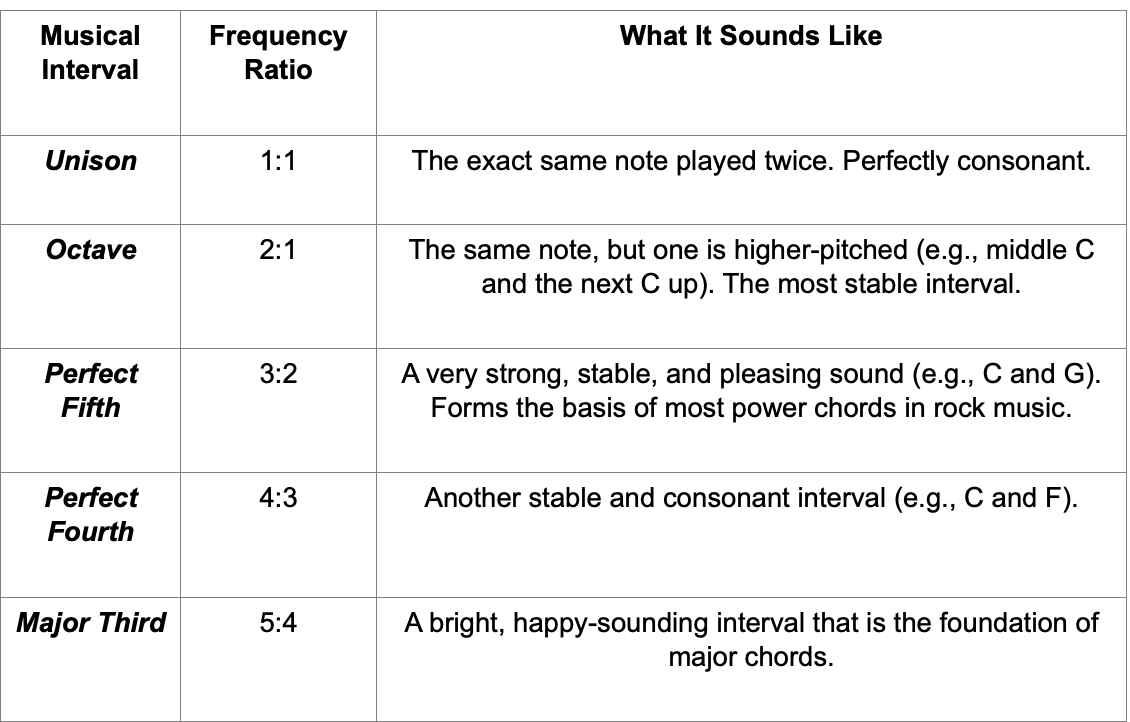
These simple ratios create sound waves that line up neatly, resulting in a smooth, blended sound that our brain interprets as harmony.
The Harmonic Series: Nature's Own Chord
The principle of simple ratios doesn't just apply to two notes played together; it's also built into the very fabric of a single note. When you play a note on an instrument, you're not just hearing one single frequency. You're hearing a fundamental pitch along with a whole series of quieter, higher-pitched notes called overtones or harmonics.
This "harmonic series" is a naturally occurring phenomenon, and its structure is purely mathematical. Here's how it works:
The Fundamental (1st Harmonic): This is the main note you hear, the lowest and loudest frequency.
The 2nd Harmonic: This overtone vibrates at twice the frequency of the fundamental (a 2:1 ratio). We hear this as an octave higher.
The 3rd Harmonic: This vibrates at three times the frequency of the fundamental (a 3:2 ratio). This creates a perfect fifth above the fundamental.
The 4th Harmonic: Vibrating at four times the frequency (4:1), this creates another octave.
The 5th Harmonic: Vibrating at five times the frequency (5:4), this adds a major third.
So, within a single C note, nature has already embedded the notes of a C major chord (C, G, and E)! This is why major chords sound so strong and natural to us—their structure mirrors the acoustic properties found in nature itself.
Dissonance: The Spice of Music
If music were made up of only simple, consonant harmonies, it would be pleasant but incredibly boring. This is where dissonance—the use of complex, clashing frequency ratios—comes in. Dissonance creates a sense of tension, instability, and suspense. Think of the unsettling music in a horror movie or the dramatic build-up in a classical symphony.
This tension is not inherently "bad"; in fact, it's a crucial storytelling tool. Musical composers use dissonance to create a feeling of longing or conflict, which makes the eventual return to consonance—what we call resolution—feel incredibly satisfying. It’s the musical equivalent of a story arc: the journey through tension makes the final, peaceful chord feel earned and emotionally resonant.
Listen With New Ears
The connection between music and math is not just an abstract theory; it's the invisible architecture behind every song you love. From the simple 3:2 ratio that gives a power chord its punch to the complex interplay of tension and release in a symphony, these mathematical principles are constantly at work, turning organized sound into a powerful emotional language.
So, the next time you listen to your favourite piece of music, try to hear beyond the notes themselves. Listen for the clean, open sound of a perfect fifth or the bright satisfaction of a major chord. By understanding the simple math that governs harmony, you can gain a deeper appreciation for the incredible artistry and inherent order that make music one of the most mysterious and beautiful forces in our lives.