

There is a statistic that haunts boardrooms everywhere: an estimated 70% of all digital transformation initiatives fail. Billions of dollars are invested in new platforms, AI integration, and sleek customer-facing apps, only for the projects to be scaled back, abandoned, or—worst of all—met with public backlash and employee rejection.
Why does this happen? Technology is rarely the primary culprit. The software usually works, the cloud is scalable, and the AI models are powerful. The failure, time and again, lies in a fundamental misunderstanding of the project's nature. Companies believe they are running a technology project when they are, in fact, running a change management project. In today's connected world, the "public"—your customers, employees, and regulators—has a more powerful voice and a more direct impact on your strategy than ever before.
When Resistance Sinks the Ship
The most expensive, sophisticated digital platform is worthless if no one wants to use it. This resistance is a two-front war: one internal, fought with your employees, and one external, fought for the trust of your customers.
Internal resistance is a well-documented challenge. Employees, often the first "users" of a new system, are not just stubborn. They are afraid. They fear new technology will make their jobs obsolete, find new workflows overly complex with inadequate training, or feel unsupported by a leadership team that simply dictates change from above. This is not a hypothetical problem. When Ford launched its "Smart Mobility" program, it struggled with internal alignment, leading to pivots and downsizing. The BBC's infamous Digital Media Initiative, which was abandoned after losing over £100 million, failed precisely because it lacked stakeholder alignment and a clear definition of value for the people who had to use it.
But the external threat—public opinion—is arguably more potent and immediate. In the past, a company could launch a new system and tell customers, "This is how we do things now." Today, that approach is corporate suicide. If a new app is buggy, if a new data policy is perceived as intrusive, or if a new automated system is seen as unethical, the public backlash is instant and amplified across social media. Any digital-first brand, from a high-street bank to an entertainment platform like Vulkan Vegas, is acutely aware that customers will switch brands after just one bad experience. This external validation, or rejection, can single-handedly determine the project's fate.
The public no longer passively accepts change; it actively judges it, and that judgment is powerful.
Public Opinion: From PR Problem to Strategic Guide
Progressive companies no longer view public opinion as a passive force to be "managed" by a PR department after a failed launch. They see it as an active, real-time feedback loop that must be integrated directly into their digital strategy from day one. Public sentiment, amplified by social and traditional media, can force a company to pivot, halt, or even reverse a major digital initiative.
This public influence is most powerful in several key pressure points. Smart organizations will actively monitor public discourse on these topics before and during their transformation, treating them as project-level risks. Here is a list of the key pressure points where public opinion can make or break a digital initiative:
Data privacy and ethics. This is arguably the number one concern. If your transformation involves collecting more customer data or implementing AI, the public will demand to know what you are collecting, why you are collecting it, and how it is being protected and used. A lack of transparent answers is a deal-breaker.
User experience (UX) backlash. Customers have high expectations set by the best apps in the world. If your new digital portal is slower, more confusing, or less functional than the "old" way, they will revolt. This feedback is not "whining"—it is a critical, free quality assurance test that you are failing.
Job-related automation. If your transformation is publicly perceived as a move to "fire workers and replace them with bots," you will face a significant reputational battle. This damages customer trust and destroys internal morale. Communicating the "human-in-the-loop" strategy and an emphasis on upskilling is critical.
Inaccessibility. If your new digital-first model excludes certain populations (e.g., the elderly who are less tech-savvy, those with disabilities, or the underbanked), you will be called out for it, and rightly so. This can lead to both regulatory and reputational penalties.
These are not just PR issues; they are core product design problems that arise from ignoring the human element.
Building Transformation on a Bedrock of Trust
If the public can shatter a transformation, it can also be the key to its success. The 70% failure rate is not a technology problem; it is a trust and communication problem. To succeed, organizations must shift from a "launch and defend" model to a "listen and adapt" one. To help visualize this, the following table contrasts the old, failed approach with the new, human-centric one.
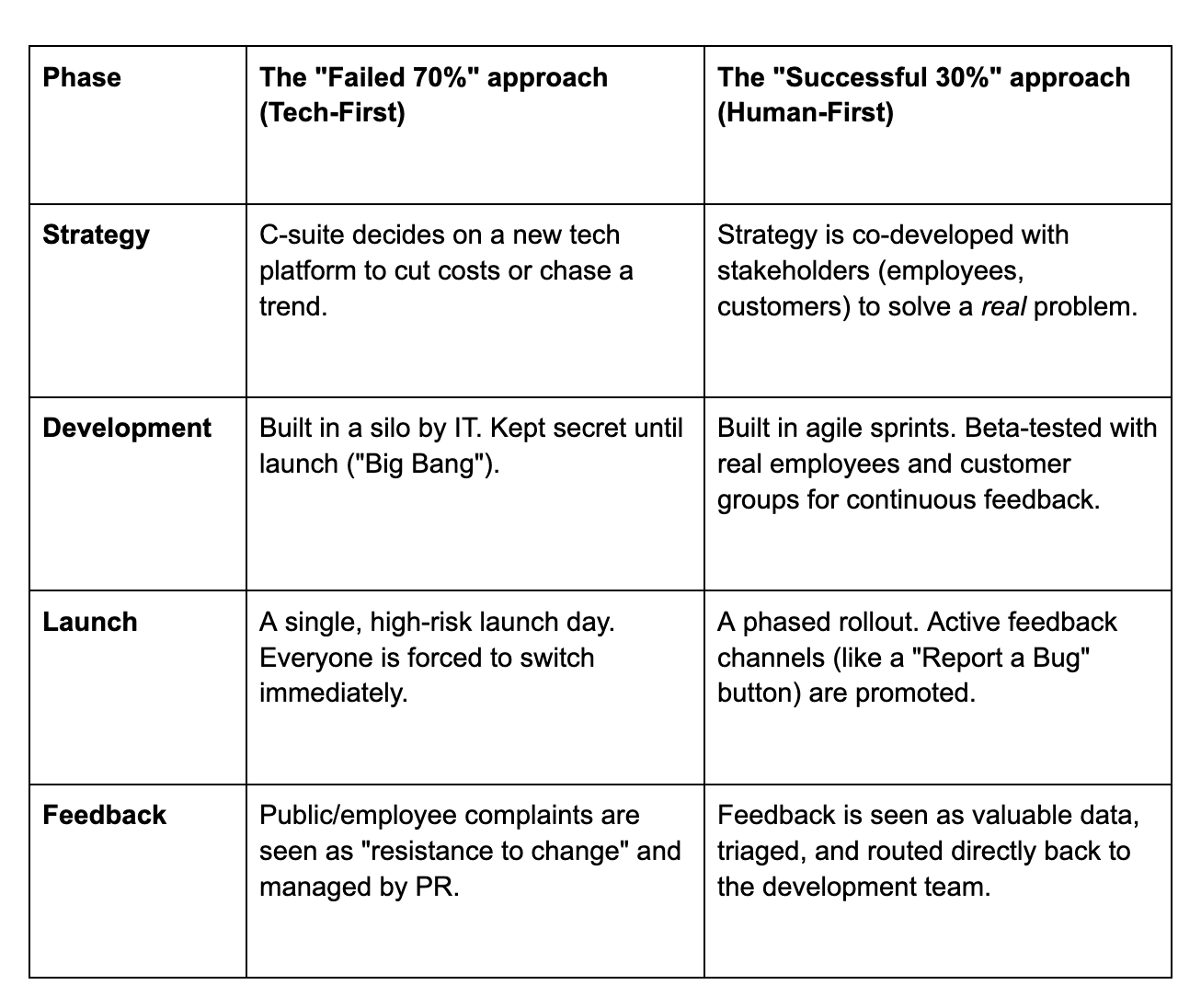
This involves embedding transparency and feedback loops at every stage of the process. Instead of building a new system in secret for two years, successful companies use agile methodologies. They release beta versions to small, controlled customer groups and actively solicit feedback. They are transparent about their goals, admitting that the process is a journey, not a magic switch. They "put people first, not systems," as one expert from Eurocities noted. This feedback loop—using social listening, beta forums, and employee councils—is not a "nice to have"; it is a vital navigational tool.
Beyond the Code: Make Your Transformation Human-First
The "digital" part of digital transformation is just the tool. The "transformation" part is, and always has been, about people. The 70% failure rate is a direct result of organizations forgetting this fact. They invest millions in the machines but not in the humans who must build, use, and ultimately trust them.
The public is not an obstacle to be overcome; it is your most important strategic asset. Their feedback, their concerns, and their trust are the raw materials from which a successful, resilient transformation is built. Ignore them, and you become a statistic. Listen to them, integrate their feedback, and you become the standard.
Before your company signs the next multi-million-dollar software contract, ask your leadership team: "What is our plan for listening to our customers and employees during this process?" Do you have a feedback-to-development pipeline? Do you have a public-facing dashboard for transparency? If the answer is no, your transformation is already at risk. Champion the creation of that feedback loop—it will be the single most valuable part of your new system.