
Move beyond instinct. Learn what Game Theory Optimal (GTO) is, how solvers work, and how to integrate this essential strategy to crush high-stakes poker.
You’re on the river in a high-stakes tournament with a tough decision against a world-class regular. Are they bluffing? Is your hand good enough to call? In the past, the answer lived in a murky world of gut instinct, timing tells, and soul-reads. Today, the best players are asking a different, colder question: "What does the solver do here?" The rise of Game Theory Optimal (GTO) strategy, powered by hyper-intelligent poker solvers, represents the most significant and disruptive evolution in the history of the game. This isn't about finding a lucky streak or playing against a fixed house edge like you would in the game at https://fortunica-online.com/en-gb ; this is about constructing a strategy so perfectly balanced that it becomes mathematically unexploitable, regardless of your opponent's actions. Welcome to the world of GTO.
For any serious player looking to compete at the highest levels, understanding GTO is no longer optional. It is the new baseline, the theoretical foundation upon which all modern strategy is built. But what does it really mean, and how can you integrate its powerful concepts without becoming a robotic, unthinking player?
Deconstructing GTO: Beyond the Buzzword
First, let's be clear about what GTO is and what it isn't. Game Theory Optimal is a strategy that, if played by two perfectly rational opponents, results in a state of "Nash Equilibrium." In poker terms, this means neither player can unilaterally change their strategy to increase their long-term winnings (or Expectation, EV). Essentially, you are playing in a way that is mathematically impossible for a perfect opponent to exploit. Its primary goal is defensive: not to maximally punish a weak player's mistakes, but to make yourself invulnerable to the adjustments of a strong one.
This represents a fundamental departure from the 'old school' way of thinking, which was almost entirely based on exploiting your opponents' tendencies.
Exploitative Play vs. GTO: The Core Conflict
The central tension in modern poker strategy lies between playing exploitatively and adhering to GTO principles. Both have their place, but understanding the difference is crucial.
Exploitative play: This is the strategy most players learn first. It focuses on identifying and attacking a specific opponent's leaks. If you notice a player folds too often to continuation bets, you c-bet against them with a higher frequency of bluffs. It's a highly effective, high-reward approach against weaker competition, but it leaves you vulnerable. If your opponent realises you're bluffing too much and starts check-raising, your entire strategy collapses.
GTO play: This approach focuses on creating perfectly balanced and mixed strategies to protect your own ranges. You bluff with the mathematically correct frequency and choose specific hands to do so, making your overall strategy unreadable. Your decisions are dictated by your hand, the board texture, and stack depths—not by your opponent's perceived tendencies. You are not trying to outsmart your opponent; you are trying to play perfect, fundamental poker.
A GTO strategy protects you from being exploited, while an exploitative strategy is how you maximise value once you've identified a clear mistake
The Engine Room: How Solvers Actually Work
The GTO revolution was made possible by one thing: the advent of poker solvers. Tools like PioSOLVER, GTO+, and Simple Postflop are essentially supercomputers for poker. A user inputs a specific, pre-defined poker scenario—including the pre-flop action, the exact hand ranges for both players, the board cards, and the stack sizes. The solver then runs billions of simulations, playing the hand against itself over and over again until it arrives at the GTO-optimal way for both players to play every single combination of cards in their range.
The outputs from these solvers were groundbreaking. They revealed that the game was far more complex than even the best human players had imagined. Optimal strategies often involved "mixed frequencies," where a specific hand should be bet 70% of the time and checked 30% of the time to remain perfectly balanced and unexploitable. For the first time, players could see what mathematically perfect poker actually looked like.
From Theory to the Felt: Applying GTO in the Real World
This brings us to the most critical question for any aspiring high-stakes player: how do you actually use this information in a real game? The biggest misconception is that studying GTO means memorising thousands of charts. This is both impossible and ineffective.
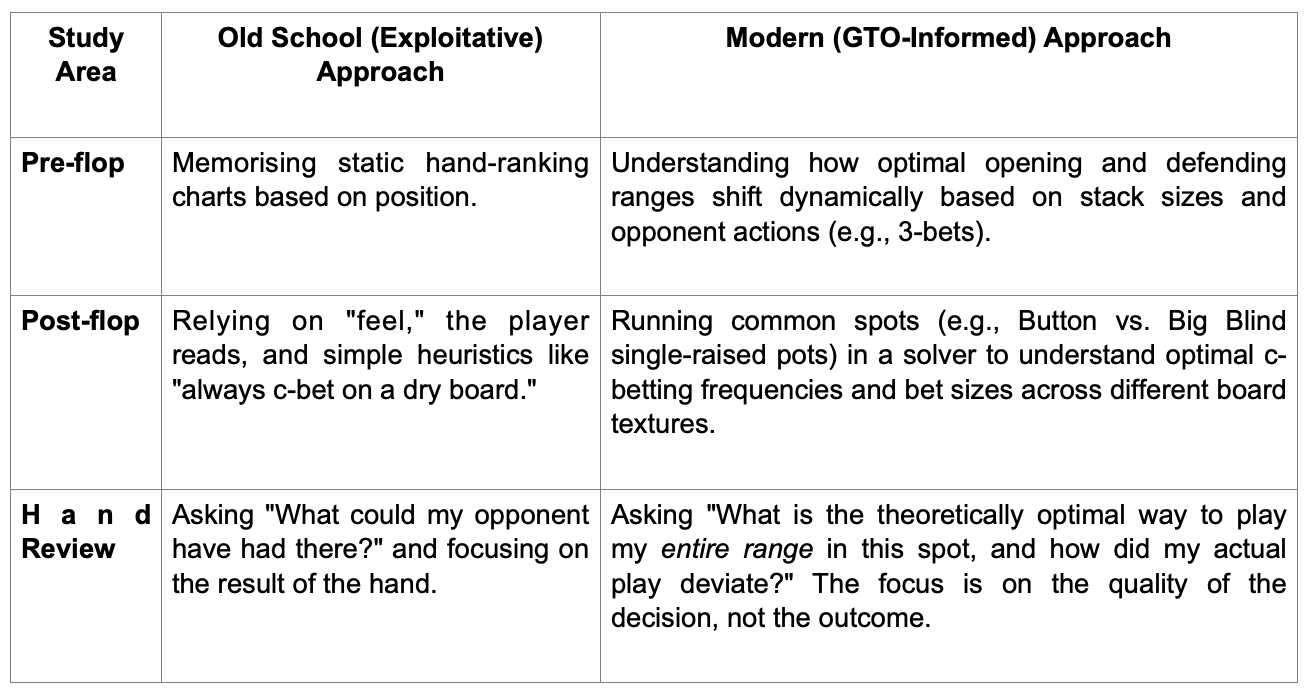
The true power of GTO comes from using it as an off-the-table study tool to refine your intuition. The goal is not to memorise the solver's outputs, but to run common scenarios and analyse the results to understand the why behind a certain play. Why does the solver prefer to check this hand on this board? Why does it use a smaller bet size with this part of its range? By internalising the underlying logic, you can make better, more theoretically sound decisions in real-time.
The table below contrasts the traditional study approach with a modern, GTO-informed methodology
Your Path Forward: Integrating GTO Without Becoming a Robot
Make no mistake: GTO is the new baseline for high-stakes poker. You cannot compete at a high level without a deep, fundamental understanding of its principles. However, the ultimate goal is not to become a GTO-robot. The art of modern poker is achieving a hybrid strategy. You start with a GTO-informed foundation—a solid, unexploitable baseline that protects you from elite opponents. From there, you must remain observant, identify clear deviations in your opponents' play, and be ready to shift to a maximally exploitative strategy to punish their mistakes.
Your challenge is not to memorise every solver output. It is to deepen your understanding. This week, take one hand that you played that left you confused or unsure. Instead of just posting it on a forum for opinions, spend 30 minutes studying that exact spot with a GTO training tool or solver. Don't just look at the answer for your specific hand; analyse the frequencies and bet sizes for your entire range. Strive to understand why the optimal play is what it is. This is how you begin to internalise the logic of GTO and truly elevate your game.