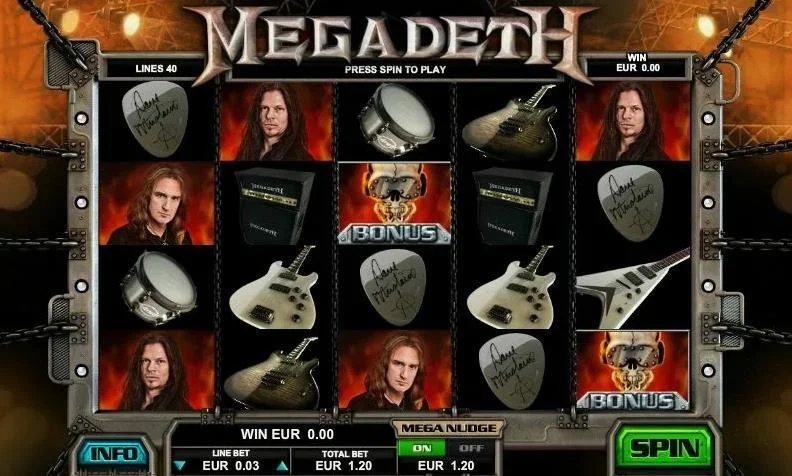
A tour poster already has the beginnings of a game screen: a huge band logo above an image that fans recognise from across a room. Moving that identity onto reels is a different proposition from printing another shirt, though. Music has to be cleared for its new use. PRS for Music's explanation of sync licensing describes negotiations that consider the proposed production and its territory, as well as the popularity of the track. Familiarity comes with paperwork.
That distinction matters when rock imagery appears in gambling. For British readers comparing music-themed games with other categories, discussion of the best online slots in the UK includes themes alongside return to player and volatility. Those are separate subjects: recognising the band does not explain the game underneath it. The UK framing also matters on a music site with an American readership. A game documented in a developer's catalogue is not proof that the same version is currently available in Britain, much less across the United States.
Where music-themed titles fit
Guns N' Roses and Motorhead have both had their identities adapted into licensed slot games. Developer documentation confirms the former's licensing deal; the latter's game description specifically mentions tracks led by Lemmy Kilmister and a stage setting. These are historical examples of bands crossing into another medium, not a current UK availability list.
For a fan, the interesting question is what survives the move. A stage backdrop can become a frame around the reels. Music can supply an immediate connection that a generic guitar symbol cannot. But recognition alone is a thin basis for an adaptation. If the artwork could be swapped for another band's without changing the experience, the licence is doing more work than the design.
Return to player concerns the game's theoretical return, rather than its soundtrack. Volatility concerns the pattern of payouts and their variation. Neither follows from whether the music sounds aggressive or restrained. A heavy riff is an artistic choice, not a description of the underlying maths.
The information behind the artwork
In Great Britain, the Gambling Commission's rules on game descriptions and the likelihood of winning require applicable rules to be easily available before a customer commits to gamble. Its guidance includes restrictions such as maximum wins among the information that may need explaining. Chances of winning must also be explained through relevant information, such as theoretical return to player or the probability of winning events.
The distinction is useful when discussing a licensed music game without turning a band feature into a recommendation. Artwork cannot stand in for those explanations. Nor does an artist's involvement establish where a release is licensed or which version a particular site supplies. A photograph of the cabinet or a promotional trailer can document the look of an adaptation; it cannot answer every question about its present distribution.
What fans remember is harder to license
A band's visual identity is only part of its appeal. A logo can be reproduced faithfully while the feeling attached to it goes missing. The songs matter because listeners have spent time with them, not simply because the lettering looks good above a set of reels. That makes the use of actual recordings a meaningful creative decision, although it does not automatically make the finished adaptation worthwhile.
The archive's Senses Fail retrospective gets closer to that relationship from the musician's side. Discussing Let It Enfold You, vocalist Buddy Nielsen calls it "the record that put us on the map" and describes it as an entry point for listeners. His comments concern an album, not gambling. They explain why an established record carries more weight than a recognisable sleeve: it has a place in the band's story.
That is the standard a music adaptation invites, even when it is only borrowing the surface. Fans can recognise a logo immediately and still disagree about whether it belongs in the new setting. The fact that a use is authorised does not settle the argument over taste.
What the deal actually means for the theme
Licensing is permission for an agreed use, not a blanket judgement about artistic quality. PRS's account of sync negotiations stresses the importance of the proposed context and whether the association fits the creator's existing image. That leaves room for a more interesting discussion than whether a famous band has simply found another place to put its name.
The strongest criticism is also the simplest: a licence should not be mistaken for a new musical statement. A game can reuse a catalogue without adding anything to it. The tour poster at least tells the audience who is on the bill. Once that poster becomes a reel layout, the band name still has to justify being there.